If you search for a Microsoft partner in Minnesota, you will find dozens of providers claiming certified expertise, and a partner ecosystem whose labels changed significantly in the last few years. “Gold Partner” no longer exists. Neither does “Silver.” The companies still advertising those badges are telling you something useful, just not what they intend.
A Microsoft partner is a company Microsoft has authorized to sell, implement, or manage its technologies, from Microsoft 365 and Azure to Dynamics and security tooling. But authorization spans a wide range, from a reseller with a registration number to a Solutions Partner with audited capability scores and advanced specializations. Knowing the difference is most of the evaluation.
This guide gives Minnesota IT leaders a working framework: which designations matter, how to verify them in five minutes, what to ask in the first call, and the red flags that predict a bad engagement.
What Microsoft partner designations actually mean now
In 2022, Microsoft replaced the old Gold and Silver competency tiers with Solutions Partner designations across six solution areas: Modern Work (Microsoft 365, Teams, Copilot), Security, Infrastructure (Azure), Data & AI, Digital & App Innovation, and Business Applications (Dynamics 365, Power Platform).
A Solutions Partner designation is not a membership fee. Partners must hit a partner capability score built from three measured components: certified staff, customer adds and retention, and demonstrated customer success with the technology. The score is recalculated continuously, so a designation reflects current capability, not a certificate earned years ago.
Above the designations sit specializations, audited validations in narrower disciplines like Adoption and Change Management, Threat Protection, or Azure Virtual Desktop, and at the top for Azure, the Azure Expert MSP program, which requires a third-party audit.
Two other labels matter for managed services buyers:
- Cloud Solution Provider (CSP): authorizes a partner to sell and manage Microsoft licensing directly. A CSP partner can right-size your licenses and own billing; a non-CSP partner cannot. Direct-bill CSPs manage the relationship themselves; indirect resellers work through a distributor.
- Legacy badges: “Gold Partner” claims on a current website mean the marketing has not been updated since at least 2022. Treat it as a signal about attention to detail.
How to verify a partner’s credentials in five minutes
Do not take the badges on a partner’s website at face value. Microsoft maintains a public partner directory (search “Microsoft AppSource find a partner”) where you can look up any company and see its current designations and specializations. Check three things:
- The designation matches the work you are buying. Modern Work for Microsoft 365 and Copilot projects, Infrastructure for Azure migrations, Security for identity and threat protection.
- The designation is current, not described in past tense or with pre-2022 language.
- Specializations exist where you have specialized needs, such as threat protection or virtual desktops.
Then verify the CSP question directly: “If we buy licensing through you, are you the direct bill partner or an indirect reseller?” Neither answer is wrong, but the answer tells you who actually controls your support escalations with Microsoft.
Seven evaluation criteria for Minnesota organizations
1. Designation fit, not designation count. A partner with the Modern Work designation and real Copilot deployment experience beats a partner with four designations and none in the area you need.
2. Managed services versus project-only delivery. Many certified partners implement and leave. If you need ongoing operations, evaluate the service desk itself: staffing model, hours, ticket SLAs, and the ITSM platform it runs on. Ask to see the SLA definitions by priority level, not the marketing summary.
3. Licensing capability. A CSP partner reviews utilization and reclaims unused licenses as part of the engagement. If licensing stays with a separate vendor, cost optimization usually falls into the gap between them.
4. Security posture as a practice, not a bullet point. Ask whether the partner operates its own security operations coverage, what stack it runs on, and how incidents flow from detection to your team at 2 AM. Minnesota’s dominant mid-market industries, healthcare, financial services, and manufacturing, each bring compliance requirements (HIPAA, examiner scrutiny, CMMC) that a generalist partner handles ad hoc and a specialized one handles by default.
5. Local presence with national depth. On-site needs, compliance walkthroughs, and quarterly reviews are easier with a partner that has Minnesota staff. But local-only providers can cap out on depth. The practical test: where are the people who will actually answer your tickets, and where are the engineers who will run your Azure environment?
6. Platform integration. If your organization runs ServiceNow or another ITSM platform, a partner that operates natively on it removes a swivel-chair layer between your service management and your Microsoft environment. Partners holding both Microsoft and ServiceNow credentials are rare and worth shortlisting when ITSM matters to you.
7. Evidence of outcomes. Ask for the metrics the partner tracks on its own performance: ticket volume trend over time, mean time to resolution, NPS or CSAT, and at least one reference in your industry and size band.
Questions to ask in the first call
- Which Solutions Partner designations do you hold today, and in which solution areas?
- Are you a direct-bill CSP? Who handles Microsoft support escalations on our behalf?
- Who specifically will we work with? A named account team, or a queue?
- What does your service desk run on, and what are your SLAs by priority?
- How do you measure whether ticket volume goes down over time?
- Which Minnesota clients in our industry can we talk to?
Red flags
- Gold or Silver Partner badges still on the website in 2026
- Certifications claimed but not verifiable in Microsoft’s partner directory
- Licensing resold with no utilization review attached
- No named account roles, only a support queue
- Security described as a feature of the tooling rather than an operated practice
- Reluctance to share SLA definitions or performance metrics before contract
Where Virteva fits
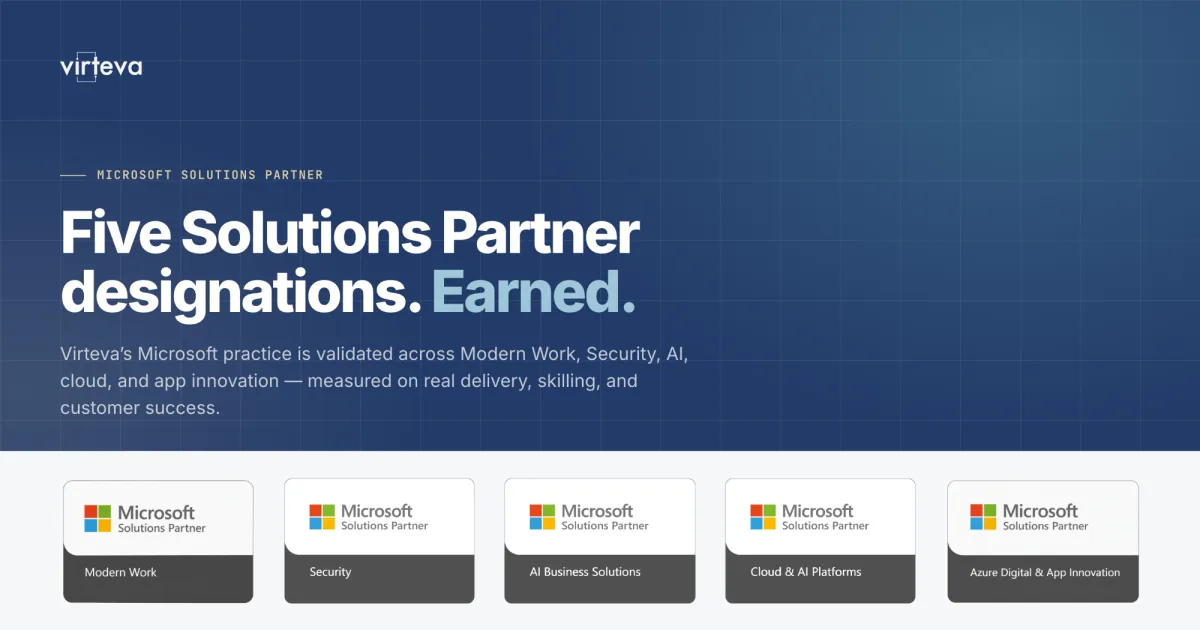
Virteva is a Microsoft Solutions Partner and Cloud Solution Provider headquartered in Minnetonka, holding five of the six Solutions Partner designations: Modern Work, Security, and all three Azure designations (Data & AI, Infrastructure, and Digital & App Innovation). It is also one of the few providers holding ServiceNow Elite Partner status alongside its Microsoft credentials. We deliver managed Microsoft 365 and Azure services, security operations on the Microsoft Defender stack, and licensing optimization for mid-market organizations in Minnesota and nationwide.
Apply the framework above to us the same way you would to anyone else: verify our designations in Microsoft’s directory, ask for our SLA definitions, and talk to our references. That is the evaluation working as intended. If you want a structured starting point, our IT services maturity assessment benchmarks your current environment against where a partner should take it.
Frequently asked questions
What is a Microsoft Solutions Partner? A Microsoft Solutions Partner is a company that has met Microsoft’s measured capability requirements in one of six solution areas, such as Modern Work, Security, or Infrastructure. The designation replaced the Gold and Silver competency tiers in 2022 and is based on certified staff, customer growth, and demonstrated customer success, recalculated on an ongoing basis.
How do I verify a Microsoft partner’s certifications? Search Microsoft’s public partner directory through AppSource for the company’s name and check its current designations and specializations. Confirm the designation matches the work you are buying and ask the partner directly whether it is a direct-bill Cloud Solution Provider or an indirect reseller.
What is the difference between a Microsoft partner and a Cloud Solution Provider? Microsoft partner is the umbrella term for companies authorized to work with Microsoft technologies. A Cloud Solution Provider (CSP) is a partner specifically authorized to sell and manage Microsoft licensing. A partner can hold Solutions Partner designations without being a CSP, in which case your licensing and its optimization live with a different vendor.
Do Gold and Silver Microsoft Partner levels still exist? No. Microsoft retired Gold and Silver competencies in 2022 and replaced them with Solutions Partner designations. A provider still advertising Gold Partner status is displaying a credential that no longer exists, which is worth noting when you evaluate how current the rest of their practice is.
Why does it matter if a Microsoft partner is local to Minnesota? Local presence matters for on-site support, compliance engagements, and working sessions, and a Minnesota-based partner is more likely to know the regulatory landscape of the state’s dominant industries, including healthcare, financial services, and manufacturing. The strongest option is usually a partner with local presence and the depth of a national practice, rather than one or the other.